WeRise · Sustainable Human Performance Under Pressure

The Arena

The world wants everything from you. This is where you take something back.

You found it.

Out there, everything wants a piece of you. Your attention. Your time. Your energy. Your answer. Your best.

The messages keep coming. The expectations keep rising. And somewhere along the way, being capable can start to feel like being permanently available.

This is a different kind of space.

Six discoveries · Practical experiences · Research and deeper reading when you want it

Not another feed to consume. Not another place telling you to work harder, think positively or become somebody else.

A place to get clear. To challenge old assumptions. To understand what pressure is doing. To discover what makes you stronger—and what might quietly be wearing you down.

Some of the ideas will feel familiar. Others might change the way you look at something you've carried for years.

Take your time. Explore. Try things. Follow your curiosity.

The real arena is out there. This is where you prepare.

Chapter 01 · The world we're navigating

The world has changed. Has our idea of resilience kept up?

It's 7:12 in the morning.

You haven't properly started your day, but somebody already needs an answer. There's a message about work. Something at home needs organising. The news is unsettling. A plan you made yesterday has changed overnight.

Nothing catastrophic has happened.

Yet your head is already full.

Read on

For years, our response to this kind of pressure was fairly straightforward: work harder, keep going, don't complain.

And sometimes that works. Grit matters. Commitment matters. The ability to keep moving when things are difficult matters enormously.

But endurance isn't an unlimited resource.

When demands keep arriving and recovery never catches up, pushing harder can gradually become the very thing that makes us less effective.

The world doesn't necessarily need less capable people.

It needs more capable ways of handling pressure.

Experience 01

The Resilience Paradox

Two ways through the same difficult week. Which one feels familiar?

A figure facing demanding conditions

Act 1 · The old contract

Push through. Shoulder it. Say yes again.

You're already stretched. Then another responsibility lands.

You say yes because people depend on you. Because you're the person who gets things done. Because stopping to explain why you can't feels harder than simply doing it.

You work later. Cancel something you were looking forward to. Promise yourself you'll recover at the weekend.

And you get through it.

That's the seductive thing about endurance. It often works—until the costs start arriving.

Strength isn't only how much you can carry. It's knowing how to carry what matters without losing yourself along the way.

Experience 02

VUCA: four ways the world throws us off balance

When the ground keeps moving, a better map matters.

VUCA describes four different kinds of difficulty. They can feel similar when you're caught in them, but each calls for a different response.

Tap a situation. Recognise the problem. Discover the move.

When things change faster than your plans can keep up.

The restructure is announced on Tuesday. By Friday, the plan has changed twice. You've worked hard preparing for something that may no longer happen.

You're not necessarily unprepared.

The conditions have changed.

Volatility is about the speed and scale of change. The facts move. The plan that made sense yesterday may need adjusting today.

The trap is gripping harder to a plan that no longer fits.

Ask: What has actually changed—and what still matters?

Keep your direction. Update your route.

Try it: Name one thing that has genuinely changed this week. What can you adjust without abandoning what matters?

Which kind of pressure is most familiar this week?

You don't need a world that stops changing. You need ways of finding your footing when it does.

Next · 02Pressure, capacity & control

Chapter 02 · Pressure, capacity & control

Pressure changes what you can see.

Think about the last time you were really under pressure.

Perhaps you moved faster. Your attention sharpened. The deadline gave you a reason to focus.

Now think about a time when the pressure went on too long.

The same mind that once felt sharp may have become scattered. Small requests felt enormous. Decisions took longer. You reacted to things you would normally handle calmly.

More pressure didn't necessarily create better performance.

Read on

The useful question isn't simply how much pressure you can tolerate.

It's how demand, available capacity, recovery and circumstances are interacting—and what you might be able to change.

Experience 03

Where does challenge stop helping?

Where does challenge stop helping?

Explore the curve. Notice how the experience changes as demands increase.

Not enough challengeUseful stretchToo much, for too long

Engaged — when the challenge feels workable.

You're alert. You're thinking. The task demands something from you, but you still have resources available to respond.

This can be a productive place to learn and grow.

What may help: Clear priorities, suitable support and enough recovery to make the effort sustainable.

Where might you be right now?

Inspired by the historical Yerkes–Dodson research. The curve is a simplified teaching illustration, not a validated measurement of someone's stress, nervous system or performance.

Experience 04

The circles of control, influence & concern

Not everything on your mind belongs in your hands.

You've probably experienced this.

Something important happens. You start thinking about it. Then thinking becomes worrying, worrying becomes rehearsing, and before long you're spending more energy on the situation than on anything you might actually be able to do.

Stephen Covey's work on proactivity gives us a powerful starting point.

The distinction isn't between things that matter and things that don't.

It's between different places where our effort can make a difference.

What is mine to do?

Your words. Your preparation. Your next decision. The boundary you communicate. The action you take.

You may not control the situation, but there are often parts of your response that belong to you.

The useful question: What can I actually do?

Example: You can't decide how someone receives a difficult conversation. You can decide how honestly and respectfully you prepare for it.

Your move: Choose one action you own.

The deadline moved again

Situation:

You're halfway through something important. Somebody moves the deadline forward, without asking what else you're carrying.

What do you focus on first?

Clarity doesn't make every problem smaller. It makes your next move easier to see.

Next · 03The Six Cs of Resilience

Chapter 03 · The Six Cs of Resilience

Six capacities. One connected human system.

Under pressure, we tend to look for one answer.

More discipline. More confidence. More motivation. More rest.

But people are more complicated than that.

Sometimes you need courage. Sometimes you need connection. Sometimes you need to make a decision, protect your energy or simply stop long enough to see clearly.

Read on

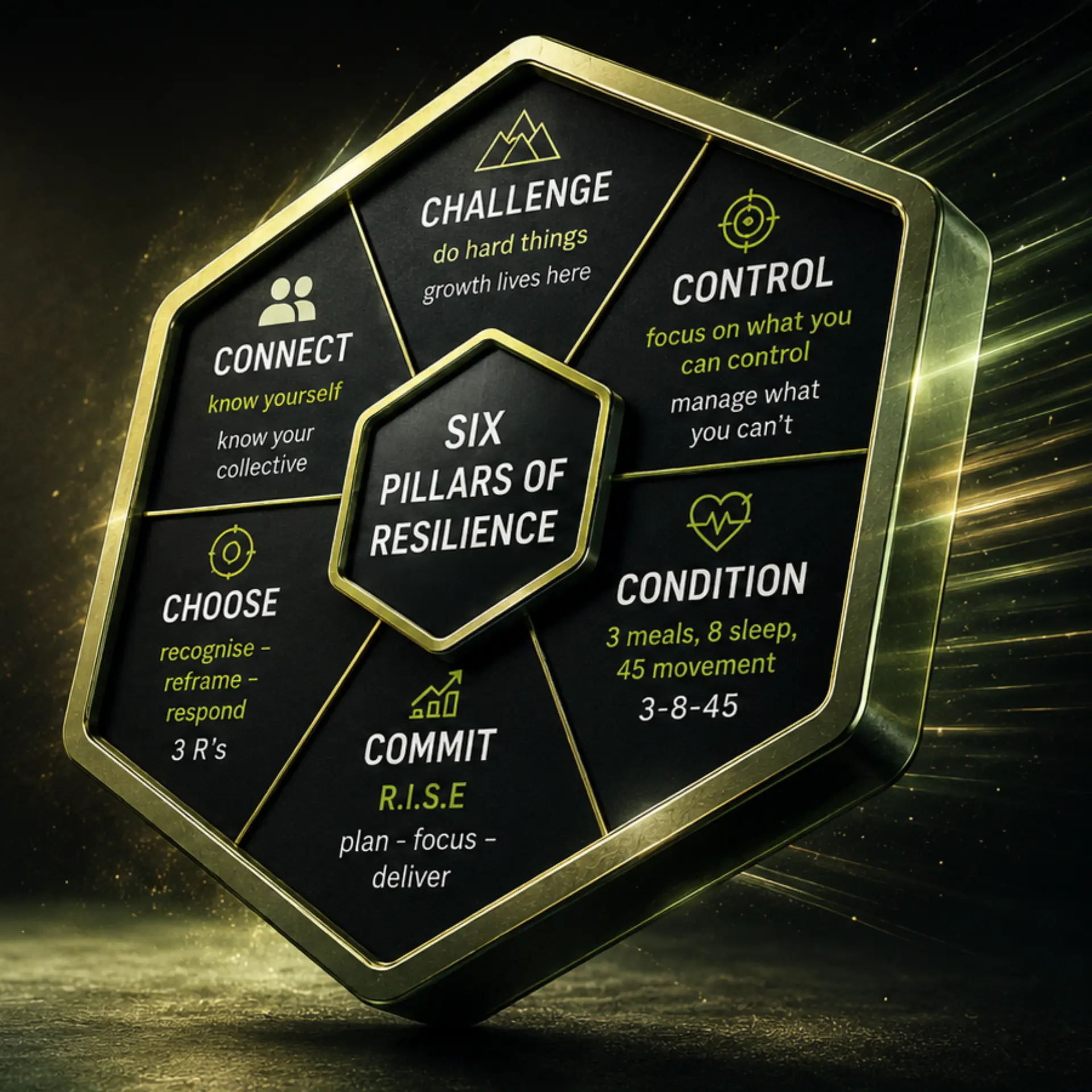
That's why WeRise works with the Six Cs of Resilience.

Not six personality types. Not six things you either possess or lack.

Six interconnected capacities you can understand, practise and develop.

Touch the framework. Explore the connections. Find the capacity that matters to you today.

Connected Six Cs of Resilience brass-edged medallion

Connect

Know yourself. Know your collective.

The strength of not having to carry everything alone.

There's a particular kind of exhaustion that comes from always being the dependable one.

People see what you manage. They don't necessarily see what it costs.

Connection is the ability to understand yourself, recognise who matters, and draw on relationships that offer perspective, belonging and practical support.

It isn't about knowing hundreds of people.

Sometimes it's one honest conversation.

A familiar moment: You're overwhelmed but keep saying, “I'm fine.”

A different response: “There's something I'm struggling to work through. Could I talk it through with you?”

Connection with Control: Knowing what you need makes it easier to ask for the right support.

Try it: Who could you speak to before the situation becomes harder to manage?

The connected framework

No single C carries the whole load.

Strong Challenge with limited Condition can make sustained effort harder.

Commit without Control can turn into activity without direction.

Control without Connect can leave somebody trying to solve everything alone.

The goal isn't six perfect scores.

It's learning which capacity to lean on, which one needs attention and how they work together.

Discover my Six Cs — Take the Personal Pressure Profile

You don't need to become a different person. You can become more deliberate about developing the capacities you have.

Next · 04The economics of capacity

Chapter 04 · The economics of capacity

Your time matters. Your capacity matters more.

You can look at a calendar and see what's booked.

It's much harder to see what each commitment is costing you.

A conversation that takes ten minutes might occupy your thoughts for hours.

A demanding day might be worthwhile, even energising—if there's enough opportunity to recover afterwards.

And something that restores one person may leave another exhausted.

That's the problem with treating every hour as though it costs the same.

Read on

WeRise looks at capacity through three connected ideas: the credits you spend and restore, the bandwidth available for different demands, and the foundations that help you recover.

Experience 05

What gives you something back? What quietly takes it away?

Think of your available energy and attention as an account.

Every day contains deposits and withdrawals.

Some are obvious. Some are surprisingly expensive. And some change depending on how you're feeling and what else is happening.

The point isn't to become obsessed with tracking yourself.

It's to notice patterns before you've spent everything.

A dinner with friends

A dinner with friends

How does this activity affect you?

What reliably gives you something back?

What costs you more than you usually admit?

If you can identify even one of each, you've learned something useful.

Try the Credits In / Credits Out experience

Experience 06

Some days, the problem isn't motivation. It's allocation.

You start with a limited amount of attention, emotional availability and practical capacity.

Then the day makes its claims.

WeRise's Bandwidth Budget uses four useful categories to make those demands easier to see.

The attention needed to think and create.

Planning. Problem-solving. Learning. Making decisions. Work that requires you to be fully present.

Ask yourself: What important work needs uninterrupted attention?

A full calendar isn't always a well-designed life.

You may not be able to remove every demand.

But you can make better decisions about what deserves focus, what can be coordinated differently, what support care requires and what space needs protecting.

If your week already feels full, which envelope most needs relief?

Experience 07

Before you ask more of yourself, look at what supports you.

When life becomes complicated, we often abandon the basics first.

Meals become whatever is convenient. Sleep gets squeezed. Movement disappears—or becomes another demand we're disappointed in ourselves for missing.

Basecamp is a simple reminder to pay attention to the foundations.

Nourishment before another demand.

Not perfect eating. Not a rigid diet.

A practical reminder to give your body the fuel and nourishment it needs.

Reflection: What would make eating well enough more manageable in your actual circumstances?

This isn't a test to pass. It's somewhere to return.

Basecamp 3–8–45 is a founder-designed reference for nourishment, rest and movement—not a universal medical prescription or a requirement to meet three fixed numbers every day.

The boundary question

Every yes has a cost. Do you know what yours is?

You're already committed to something important.

Another request arrives.

You could probably squeeze it in. You usually do.

But what would you be squeezing out?

A boundary isn't necessarily a refusal. Sometimes it's a more honest agreement.

Try saying:

  • Yes, with a trade-off: “I can do this, but we'll need to move something else.”
  • Not yet: “That matters. I can't give it the attention it needs today.”
  • No, with clarity: “I can't take that on. Here's what I can offer instead.”
  • I need support: “I don't think this is workable without changing the load or getting help.”

The question worth remembering: What will this yes require me to say no to?

Boundaries are useful, but they cannot make unsafe or unfair conditions safe. Some problems require organisational change or specialist support—not more responsibility placed on the individual.

The Purpose Compass

You can protect your capacity. But what are you protecting it for?

Not everything worthwhile is urgent.

And not everything urgent deserves the best of you.

The Purpose Compass helps you look for a direction worth investing in.

It explores four questions—not to declare your destiny, but to reveal possibilities.

PASSION — WHAT HOLDS YOUR ATTENTION?

Think of something you've done that felt absorbing or worthwhile.

You didn't necessarily find it easy. You simply cared about doing it.

Explore: Was it creating, solving, helping, teaching, learning, building or something else?

Purpose isn't always found in a grand revelation.

Sometimes it appears where something you care about meets something you can contribute.

And the next step isn't to change your life overnight.

It's to test a direction.

Try it: What small contribution could you make in the next seven days that would tell you something useful about what matters to you?

The four-circle Purpose Compass is a modern Western synthesis inspired by purpose and contribution concepts. It should not be presented as the historical Japanese definition of ikigai. Purpose also exists in family, care, community, learning and ordinary life—not just paid employment.

Sustainable performance isn't about having unlimited capacity. It's about using and protecting the capacity you have for things that matter.

Next · 05The moment you choose

Chapter 05 · The moment you choose

You don't always control what happens next. But you can practise how you meet it.

Some of life's most important moments arrive without an appointment.

The unexpected question. The difficult conversation. The message that changes your plans. The criticism that lands harder than you expected.

A reaction starts forming before you've had much time to think.

Your shoulders tense. Your thoughts speed up. You're already preparing an answer.

Read on

Sometimes that first response is useful.

Sometimes it's the beginning of a problem you didn't need to create.

WeRise trains a more deliberate way of meeting those moments.

Experience 08

Recognise. Reframe. Respond.

A useful response begins with noticing what's happening.

You receive a message

“We need to talk.”

First thought: “I've done something wrong.”

Catch the moment before it carries you away.

Notice what pressure is changing.

Your breathing. Your tone. The story in your head. The urge to withdraw, argue, agree or react.

You don't need to judge the response.

First, notice it.

The question: What's happening in me right now?

Example: “My manager's just challenged my work. I can feel myself becoming defensive.”

Recognise: I'm anxious, and I'm already assuming the outcome.

Insight: You haven't changed the message. You've changed what happens before you respond to it.

The Three Rs are a practical WeRise reflection tool, not a guarantee that everyone can consciously interrupt every reaction under every circumstance.

Experience 09

When everything feels tangled, give the problem somewhere to go.

Knowing you need to act isn't the same as having a workable plan.

RISE is the WeRise framework for moving from noise towards deliberate execution.

Four questions. One useful direction.

See the ground before you move.

What is actually happening?

What do you know? What are you assuming? What is changing? What constraints or risks matter?

The question: Where are we now?

Example: “The deadline has moved forward. Two tasks compete for the same time. I haven't clarified which one matters most.”

Your move: Separate facts, assumptions, risks and unknowns.

What's the situation you're facing?

Experience 10

Psychological capital: HERO

Researchers use the term psychological capital—or PsyCap—to describe four positive psychological resources associated with how people pursue goals and respond to setbacks.

The four are remembered as HERO.

This doesn't mean becoming relentlessly positive, ignoring legitimate difficulties or treating resilience as a personality contest.

It means recognising resources that may be developed and supported.

More than wishing for a better outcome.

Hope involves having something worth moving towards and being able to imagine routes towards it.

When one route closes, another may still be possible.

Ask yourself: What's the outcome that matters—and what's another way to move towards it?

You don't need to be all four things, all the time.

You can practise useful ways of thinking, planning and recovering without pretending everything is under your control.

Pressure may narrow your options. Preparation, perspective and practice can help you find more of them.

Next · 06The work begins out there

Chapter 06 · The work begins out there

You don't build capacity by collecting ideas.

You build it by using them.

The difficult conversation still needs to happen.

The decision still needs making.

The boundary still needs holding.

And the next unexpected challenge won't wait until you feel completely ready.

Read on

That's why The Arena isn't the destination.

It's a place to understand, prepare and practise for the life outside.

Experience 11

Start where you are. Not where you think you should be.

Start where you are. Not where you think you should be.

Think about one worthwhile thing you've been avoiding or postponing.

You don't have to tackle the biggest version of it today.

Start with the smallest action that would genuinely count.

Experience 12

Don't just get through the moment. Learn from it.

Don't just get through the moment. Learn from it.

We often finish a difficult experience and move straight into the next demand.

But a useful question can turn experience into understanding.

An After Action Review—AAR—is a short, honest look at what happened.

Not to punish yourself.

Not to prove everything went brilliantly.

To learn.

What was I trying to do?

What mattered? What outcome was I aiming for?

The insight: Even a successful outcome can contain important lessons. Even a difficult attempt can teach you something worthwhile.

This is where Unbreakable 45 begins to feel different from simply reading about resilience.

A woman walking through a mountain landscape

Unbreakable 45 · The first training journey

Forty-five days to build a more deliberate way of responding.

Not forty-five perfect days.

Not a contest to see who can suffer most.

A structured opportunity to learn, practise and reflect on how you handle pressure in your real life.

You choose a meaningful challenge. You work through six stages of development. You practise with tools from the WeRise framework. You take manageable actions outside the app and bring the learning back.

  1. Understand how pressure affects you. Choose a challenge worth working on.

    Your takeaway: My Pressure Mission.

Days 43–45

REVIEW. REBUILD. RISE.

Look back at what you've genuinely tried, what you've learned and how your approach has changed.

Learning isn't complete because a calendar reaches Day 45. The programme's completion process includes reviewed real-world practice and a saved course conclusion.

Pauses, recovery and returning after interruptions are part of the journey.

You're not building a perfect streak. You're building something you can keep using.

Inside the Unbreakable Practice Club

Day 45 isn't the end of the story.

Life keeps changing. The situations we need to navigate change with it.

The Unbreakable Practice Club is intended to give you a place to keep practising.

New challenges. Work on the situations that matter in this season of your life.

Focused Field Courses. Go deeper into skills such as boundaries, difficult conversations, decisions and recovery as programmes become available.

Pressure Labs. Join genuine scheduled learning and practice sessions when offered.

Your Pressure Playbook. Keep a private record of the useful actions you've tried, the insights you've gained and the adjustments that work for you.

The aim isn't to spend more time on a screen.

It's to become better equipped for the time you spend away from it.

Unbreakable 45 is the foundational training experience included within membership. It is not a separate one-off purchase followed by another compulsory subscription.

The invitation

The arena is out there. Come and prepare for it.

You don't have to wait for a crisis to work on yourself.

You can begin while life is relatively steady. Or when things are already demanding more than you'd like.

You bring the challenge.

WeRise brings the ideas, structure and opportunities to practise.

Existing members: Sign in to my Practice Club

Founding membership is currently by enquiry and invitation. There is no instant paid enrolment. Programme resources and live experiences will be made available as they are developed and scheduled.

From the bookshelf · The thinking behind WeRise

Go beyond the introduction.

TIME UNDER TENSION

Building the Resilience Muscle — Justin Meredith

The ideas behind The Arena began with a simple question: how do we remain capable, adaptable and human when life keeps adding pressure?

Explore the stories, principles and practical tools behind the Six Cs, tactical resilience, Credits, RISE, presilience and recovery.

Explore Time Under Tension

HIGH PERFORMANCE & BOUNDARIES

Justin Meredith

Being dependable shouldn't mean being endlessly available.

Explore the practical work of protecting attention, setting boundaries, managing competing demands, recovering deliberately and learning when—and how—to say no.

Explore High Performance & Boundaries

Justin Meredith — High Performance & Boundaries.

Founder material on boundary-setting, attention, recovery, saying no and managing competing demands.

A verified book information or purchase destination is not available yet.

Take what you've learned. Use what matters.

You don't need to remember every framework on this page.

You don't need to become someone who handles every difficult moment perfectly.

Find one thing that makes sense to you.

Try it somewhere real.

Notice what happens.

Keep what helps. Change what doesn't.

That's how we build the muscle.

WERISE — SUSTAINABLE HUMAN PERFORMANCE UNDER PRESSURE

Important boundaries

The Arena is an educational experience. The Six Cs, RISE, Basecamp, Credits and related exercises are WeRise frameworks and teaching tools.

They are not clinical diagnoses, calibrated measurements of physiological stress or independently validated psychometric instruments.

Research on related psychological concepts does not establish that the WeRise models have been scientifically validated or that using the programme guarantees an outcome.

The purpose is to support reflection, learning and practical action—not replace medical care, mental-health support or organisational responsibility for safe working conditions.

Browse the full reference library